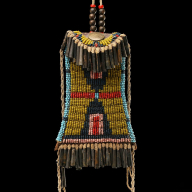
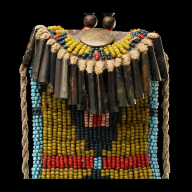
Among the warrior cultures of the 19th-century North American Plains, personal battle deeds, leadership rank, and war honors were publicly displayed through specialized head and hair regalia. Unlike rank-specific emblems restricted to initiated officers of closed military sodalities, these earned insignia functioned as visual biographies of a warrior's service, courage, and social standing within the tribe.
Across Northern, Central, and Southern Plains nations, head and hair regalia encompassed several distinct traditional forms:
- Eagle-feather war bonnets: flaring, straight-up, and single- or double-trailer headdresses constructed from Golden Eagle tail feathers, porcupine quillwork, seed beadwork, and winter ermine pelts, earned through cumulative battle honors and tribal consensus;
- Coup feathers & vertical plumes: single Golden Eagle tail feathers notched, painted, tipped with horsehair, or wrapped in quillwork to signify specific martial exploits (coups), worn upright at the crown of the head;
- Hair ornaments & roaches: porcupine-guard-hair and deer-tail roaches mounted on bone or antler spreaders, bone hairpipe hairbows, quilled rawhide hair plates, and beaded hair ties securing the braids or scalp lock.
The originals and historical reproductions cataloged in this section of the «4 Colors» Gallery follow documented 19th-century museum specimens in material, proportion, and traditional construction.